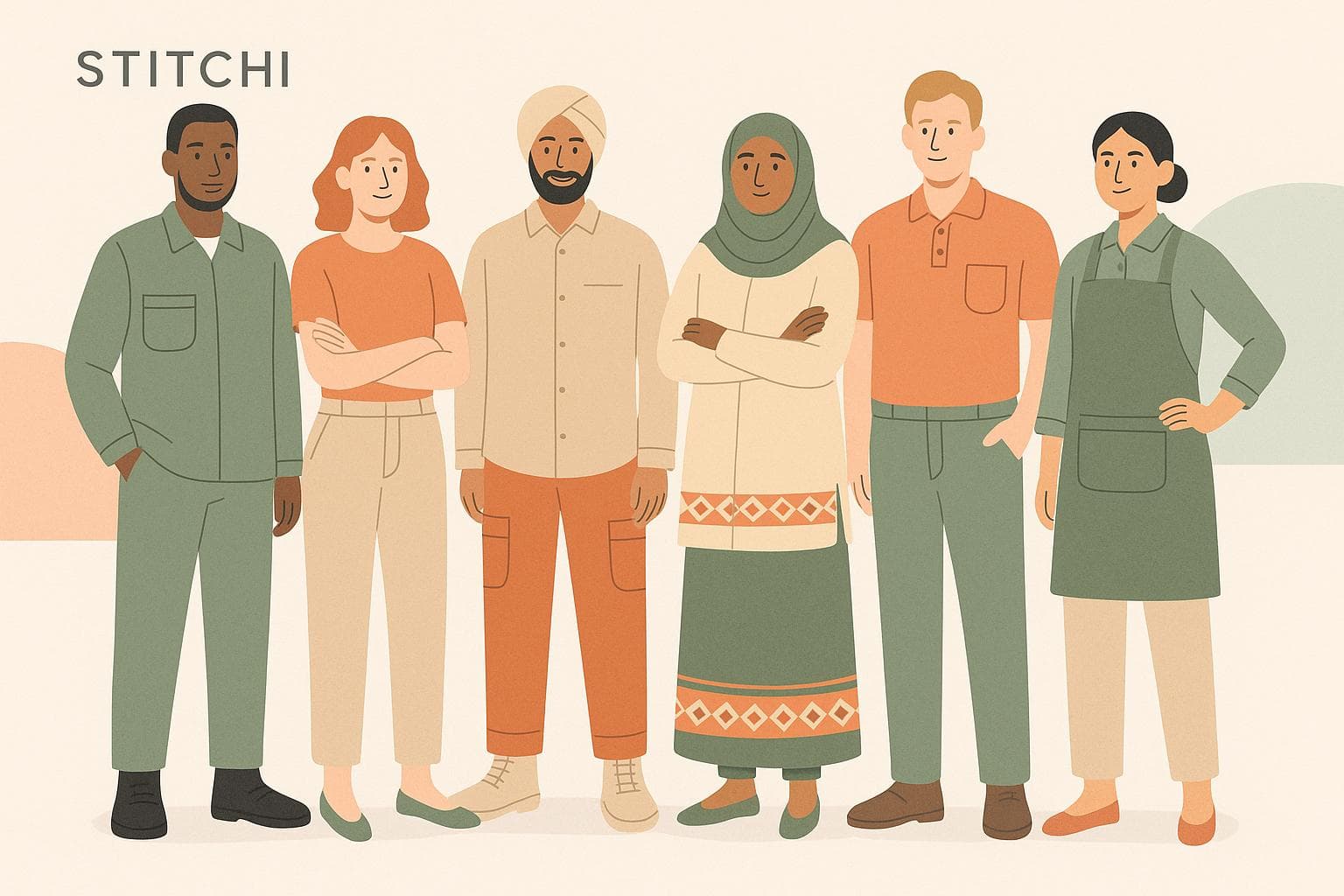
How to Design Workwear for Diverse Teams
Creating workwear that fits everyone's needs is essential for safety, comfort, and productivity. Here's a quick breakdown of how to make workwear suitable for all employees:
- Understand Your Team's Needs: Conduct surveys and audits to gather data on body types, sizes, religious practices, and accessibility requirements.
- Expand Size Options: Offer a wide range of sizes, including petite, tall, and plus-size, with proportional adjustments to ensure proper fit.
- Choose the Right Fabrics: Prioritize stretch, moisture-wicking, and durable materials for comfort and performance.
- Respect Personal Preferences: Provide options for cultural or religious attire, such as longer sleeves or head coverings.
- Design for Accessibility: Add features like magnetic closures, elastic waistbands, and adjustable elements for employees with different physical needs.
- Test and Refine: Use wear trials to gather feedback and make improvements before full production.
- Communicate Clearly: Share fitting guides, feedback channels, and program details to ensure employees feel supported.
Workwear / Uniforms Garment Fit & Sizing for Today’s Workforce
Step 1: Assess Your Team's Requirements
Understanding your team's needs is the foundation for creating workwear that works for everyone. Skipping this step often leads to uniforms that miss the mark - whether they don’t fit properly, fail to respect personal or cultural preferences, or don’t accommodate employees with disabilities. Taking the time to gather real data ensures you're designing with purpose, not just guessing.
Conduct a Workforce Diversity Audit
A diversity audit helps you get a clear picture of what your team truly needs. It’s not just about headcount; it’s about understanding the unique characteristics that impact fit and functionality.
Start by collecting details about body types and sizes. This means documenting height ranges, builds (from petite to tall, slim to curvy), and any additional physical factors that could influence fit. By mapping out these real measurements, you’ll know the size range your workwear needs to cover[1][9].
Next, consider cultural and religious practices. Some employees may need longer coverage or prefer gender-specific or gender-neutral options. Recording these preferences ensures you’re meeting actual needs, not making assumptions[1].
Don’t forget about accessibility and physical considerations. A 2023 Safe Work Australia study revealed that over 35% of workers reported poor-fitting protective gear as a major distraction that reduced focus and increased fatigue on the job[9]. Identify employees who may need adaptive features, such as those with limited mobility, reach, or dexterity. These are not rare cases - they’re essential to ensuring everyone can perform their job safely and comfortably[2][8].
Finally, assess job-specific needs. For example, construction workers may require clothing with extra stretch for movement, while warehouse staff might need versatile layering options. Documenting these role-based variations ensures your workwear program addresses the full range of functional requirements[9].
Once your audit is complete, validate your findings by engaging with your team directly.
Collect Employee Input
HR records only provide part of the story. To truly understand what your team needs, you need feedback from the people who will wear the workwear every day.
Anonymous surveys are a great way to gather honest opinions. Ask about current comfort levels, fit issues (e.g., waist, length, shoulders), and preferences for features like adjustable waistbands or stretch panels. For instance, when Bisley Workwear surveyed over 1,000 tradies in 2022, 87% said inclusive sizing options were important to them[9].
For cultural and religious considerations, use an opt-in approach. Let employees voluntarily share what they’re comfortable disclosing, and emphasize that participation is optional[2].
When addressing accessibility needs, use thoughtful, inclusive language. Focus on practical aspects like reach, dexterity, and mobility - key factors that influence how people interact with clothing. For example, ask if employees have difficulty reaching certain areas, limited hand strength, or use mobility aids. Avoid deficit-focused terms and instead frame questions around "accessibility needs" or "physical considerations"[2][8].
Provide multiple feedback channels to suit different preferences. Written surveys, in-person discussions, and anonymous suggestion boxes all help ensure you’re hearing from everyone, not just the most vocal employees.
Focus groups and listening sessions can add depth to your understanding. Bring together representatives from various departments, body types, cultural backgrounds, and ability levels. These sessions allow employees to share how current workwear impacts their daily tasks and highlight needs that might not be obvious from surveys alone[1].
Once you've collected all this information, analyze it carefully. Organize data into categories like sizing, cultural preferences, and accessibility needs. For example, segment sizing data to identify the full range of sizes required. Group cultural and religious feedback to spot common themes. For accessibility, consider how often certain needs arise and how significantly they affect employees’ work. If 20% of your team has mobility-related concerns, adaptive features should be treated as essential, not optional[2][8].
Rank the findings based on how many employees are affected, how much it impacts their work and well-being, and how feasible it is to address through design. This approach ensures you’re prioritizing the most critical needs first[1].
Document everything in a clear, detailed report. This will serve as a guide for your design team and manufacturing partner. Investing time in this assessment phase pays off when you deliver workwear that fits your team - every single one of them.
Step 2: Design for Different Body Types and Sizes
Leverage your team's data to create workwear that truly fits their needs. Traditional workwear often relies on standard sizes and generic fits, which can leave many employees feeling uncomfortable or excluded [1]. People come in all shapes and sizes - not just in terms of numerical size but also in proportions, body shapes, and functional requirements. Designing inclusive workwear means going beyond simply scaling up a medium to create a 2X. For instance, someone wearing a 2X might have a longer torso compared to their legs or broader shoulders in relation to their hips [1][3]. To address this, focus on two critical areas: expanding the size range and ensuring a consistent fit.
Expand Your Size Range
Creating an extended size range isn’t just about adding more sizes; it’s about addressing diverse dimensions like height, width, and length. Move past the generic "average" body type by offering petite, standard, and plus-size options that account for different proportions [1][3]. For example:
- Provide petite lengths for shorter employees and extended lengths for taller workers.
- Design proportional sizing that considers variations like a larger waist paired with standard sleeve lengths or adjustments across multiple dimensions.
Uniform pattern grading often falls short when it comes to real-life body differences. For example, a petite size shouldn’t just be a scaled-down version of a standard size - it needs a shorter rise and inseam without shrinking every dimension proportionally. Relying solely on proportional grading can lead to issues like sleeves that are too long, misaligned rises, or unnecessary extra fabric, all of which can compromise comfort and safety. Use your audit data to identify specific sizing gaps and prioritize addressing those first.
Additionally, offering multiple fit options can better meet employees’ preferences and functional needs [1][3]. While some may prefer a tailored, fitted look, others might opt for a relaxed cut to allow greater mobility. For example, provide both fitted and relaxed styles to accommodate varying preferences. Gender-neutral designs with straight, adaptable cuts and adjustable features can also serve as a versatile base. Involving a diverse team in the design review process ensures the final options reflect your workforce’s needs [5]. Once you’ve expanded your range, the next challenge is maintaining a consistent fit across all sizes.
Maintain Consistent Fit Across Sizes
Expanding your size range is just the first step - ensuring the fit remains consistent across all sizes is equally important. This requires thorough testing and close collaboration with your manufacturing partner. Conduct wear trials and 3D fit testing to confirm consistent fit across the entire size spectrum [6]. Gather feedback from employees of different body types during these trials and use their input to fine-tune the designs before moving to mass production.
For example, a 2022 survey of over 1,000 trade workers by Bisley Workwear revealed that 87% preferred Flx & Move styles, which feature stretch fabrics and modern cuts, over traditional workwear - especially in physically demanding roles [9]. By working closely with manufacturers, you can establish clear fit specifications that outline key measurements, proportions, and garment behavior. This ensures that a medium in one style fits according to the same principles as a medium in another.
Provide detailed size charts to help employees select the right fit. Go beyond basic size labels by including multiple measurement points, such as chest/bust, waist, hips, sleeve length, inseam, and rise. For instance, include instructions like measuring the chest by wrapping a tape measure around the fullest part of the bust, keeping the tape parallel to the ground. Visual guides or photos of real people wearing different sizes can also make the selection process easier and more accurate.
Finally, establish feedback systems to refine sizing over time. Post-wear surveys and tracking return or exchange rates by size can help identify recurring issues. When employees see their feedback leading to tangible improvements, it reinforces their sense of inclusion and the organization’s commitment to their comfort.
Prioritizing well-fitted, high-quality workwear sends a powerful message: every employee deserves to feel comfortable, safe, and valued at work [1]. While the initial effort to expand size ranges and maintain consistent fit may require extra resources, the payoff includes better morale, higher productivity, and a safer workplace overall.
Step 3: Select Comfortable and Practical Fabrics
After determining the right size range and fit, the next step is choosing fabrics that cater to your team’s daily needs. The materials you pick play a big role in how comfortable your employees feel during their shifts and how long the workwear lasts. With fit addressed, focusing on comfort and performance through fabric selection becomes the next priority.
Focus on Fabric Technologies That Work
To complement your size range and ensure consistent fit, choose fabrics designed to support both movement and durability. Different work settings call for specific fabric solutions tailored to the challenges your team faces every day.
- Stretch materials: These allow for greater flexibility and accommodate various body types without restricting movement. Employees can perform their tasks more comfortably and confidently [1].
- Moisture-wicking fabrics: These pull sweat away from the skin, helping to regulate body temperature and keep employees comfortable throughout long shifts [3].
- Temperature-regulating fabrics: Ideal for teams working in diverse environments, these breathable materials allow for layering without adding bulk, whether employees are in climate-controlled spaces or braving outdoor conditions [9].
Durability is equally important. Fabrics with reinforced fibers or fade-resistant treatments ensure the workwear maintains its professional look and protective qualities, even after frequent washes or exposure to tough conditions. Stretch fabrics, in particular, are a game-changer for physically demanding roles, especially for workers who bend, climb, or reach frequently.
Prioritize Comfort and Usability in Design
Fabric choice is just one piece of the puzzle - how the garment is constructed matters just as much. Thoughtful design features can make workwear more inclusive and practical for a diverse workforce.
- Adjustable elements: Features like adjustable waistbands, stretch panels in high-movement areas, and reinforced gussets at stress points improve mobility and durability while catering to different body shapes [1].
- Ergonomic seam placement: Seams placed strategically can reduce strain and improve comfort. For example, moving side seams slightly forward prevents irritation during repetitive arm movements. Flat-felled or French seams create smoother finishes, which is especially helpful for employees wearing workwear for extended periods [1].
- Layering systems: Modular designs, such as removable sleeves or convertible pant legs, allow employees to adapt their clothing to their specific needs. This is especially valuable for those with varying physical abilities, as it accommodates differences in reach, dexterity, and mobility [2].
Accessibility is another key consideration. Traditional buttons and zippers might be difficult for employees with limited dexterity, so alternatives like magnetic closures, hook-and-loop fasteners, or oversized buttons can make a big difference [2]. Pocket placement is equally important - accessible pockets ensure employees can easily store tools, personal items, or work necessities.
When balancing form and function, prioritize the functional requirements of your work environment. Whether it’s exposure to hazardous materials, extreme weather, or repetitive tasks, select fabrics that provide the necessary protection and durability first. Once those needs are met, you can focus on enhancing the design to boost overall appeal without sacrificing safety or performance [1].
Validate Your Choices Through Wear Trials
Before committing to full production, conduct wear trials with a diverse group of employees. Include individuals of varying sizes, body types, physical abilities, and roles. Have them test the garments in real-world conditions for two to four weeks and gather detailed feedback on comfort, fit, durability, and functionality [5]. Use a structured feedback process to address specific areas: Does the fabric breathe well? Are the adjustable features effective? Do the seams hold up under stress?
This testing phase ensures that your fabric and design choices meet the needs of your team before scaling up production. Plus, when employees see their input being used to improve the workwear, it reinforces their sense of inclusion and highlights the organization’s dedication to their comfort and safety.
Step 4: Account for Cultural and Religious Considerations
Once you've settled on fabric and fit, the next step is addressing cultural and religious needs. Workwear should respect these practices by offering options that align with employees' standards. This effort creates an environment where everyone feels valued and included.
Offer Coverage Options
Some employees require specific coverage to meet their cultural or religious practices. For example, Muslim employees might need hijabs, long sleeves, and loose-fitting attire. Orthodox Jewish employees often prefer modest clothing that covers the collarbone and knees, while Sikh employees may need designs that accommodate turbans or other head coverings [1]. To meet these needs, consider providing longer-length garments, such as tunics, maxi skirts, or full-length pants, that maintain a professional look while offering the necessary coverage. Modest necklines and sleeves that cover the arms should also be standard options in your workwear program rather than special exceptions.
You can incorporate these coverage options while maintaining functionality by using breathable, stretchable fabrics and incorporating adjustable elements. Modest tailoring ensures the clothing meets cultural and religious needs without compromising practicality. Gathering direct feedback from employees can help confirm that these designs meet their expectations. These versatile options can also lay the groundwork for more inclusive, gender-neutral designs.
Include Gender-Neutral Designs
Gender-neutral workwear is a step toward inclusivity, allowing employees to choose clothing that suits a variety of body types and gender identities. By moving away from the traditional divide between men's and women's lines, employees can select garments that reflect their personal style and comfort preferences. The foundation of gender-neutral designs includes straight, adaptable cuts, adjustable features, and a wide range of sizes to accommodate different body shapes.
Practical options like hi-vis vests and coveralls can be designed with functionality and comfort in mind. Focus on ergonomic seam placement, breathable materials, and tailored silhouettes to reduce discomfort and avoid unnecessary strain.
Introducing gender-neutral workwear not only supports individual expression but also fosters a cohesive, professional image - especially in industries where uniforms are both a necessity and a representation of company identity. To ensure these options work for everyone, consult with employees from diverse backgrounds to understand their sizing and fit needs. Forming an internal committee with representatives from different parts of your workforce can also help guide these decisions.
Lastly, establish consistent feedback mechanisms - whether through surveys, focus groups, or routine reviews - to keep your workwear program relevant and responsive to your team's evolving needs. This ongoing effort underscores your commitment to creating workwear that reflects the diversity of your team.
sbb-itb-6f489d9
Step 5: Design for Accessibility and Physical Changes
Creating workwear that meets the needs of every team member means addressing accessibility challenges and adapting to evolving physical requirements. This goes beyond offering a range of sizes - it’s about integrating thoughtful features that ensure functionality for individuals with disabilities and those undergoing physical transitions. The goal is to design clothing that works for everyone, regardless of physical ability or life stage.
Add Adaptive Design Elements
Adaptive design features make workwear more practical for employees with diverse levels of mobility, dexterity, and reach. The IAD framework identifies varying levels of difficulty that call for specific design strategies[2]. For minimal challenges, ergonomic details like breathable fabrics and carefully placed seams can reduce discomfort. For moderate challenges, modular designs - such as detachable sleeves or adjustable closures - allow customization. For more severe difficulties, specialized garments can be engineered to accommodate needs like prosthetic integration or medical devices.
Simple adjustments can make a big difference. Magnetic closures, Velcro fastenings, and oversized buttons are easier to manipulate for employees with limited dexterity. Enlarged zipper pulls or fabric loops can improve grip, while side zippers or open seams simplify dressing for those with reduced motor control.
Elastic waistbands and stretch panels enhance flexibility, making garments more accommodating for movements involving wheelchairs or walkers. Poorly fitting workwear, including personal protective equipment (PPE), is a significant distraction for over 35% of workers, highlighting the importance of proper fit and functionality[9].
Durability is another key factor. Reinforced gussets in high-stress areas help garments withstand wear from repetitive movements, while ergonomic seam placement reduces strain by keeping seams away from pressure points[1]. Adjusting garment proportions - like shortening sleeves, modifying armhole placement, or repositioning pockets - ensures that essential features remain accessible for employees with limited reach.
When designing for employees who use mobility aids, consider how clothing interacts with equipment. Reinforced areas at stress points and adjustable sleeve or pant lengths can improve usability. Testing these features with employees who face dexterity or mobility challenges ensures that the designs address real-world needs rather than theoretical assumptions.
Accommodate Physical Transitions
Workwear should also adapt to employees’ changing physical needs, such as those arising from pregnancy, menopause, or other hormonal changes. These transitions often bring challenges like temperature fluctuations and fit issues that standard workwear fails to address. Flexible features can provide comfort while maintaining a polished, professional appearance.
Adjustable waistbands that expand or contract seamlessly are a simple yet effective solution. Instead of limiting stretch to specific panels, incorporating stretch fabrics throughout the garment allows for better accommodation of weight distribution and growing midsections, while still ensuring a proper fit in areas like the shoulders and arms[1][9]. Clothing designed for layering also helps employees adapt to temperature changes without adding unnecessary bulk.
Breathable, moisture-wicking fabrics with strategically placed mesh panels - such as under the arms or along the back - can help manage temperature fluctuations efficiently. Adjustable closures, like partial zippers or snap-button fronts, allow employees to control coverage and ventilation throughout the day.
Modular designs, where garment components can be adjusted or replaced, offer practical solutions for temporary or gradual changes. Providing multiple length and width options ensures that clothing continues to fit well as body proportions shift, without compromising a professional appearance.
Real-world testing is essential. Sample trials with employees experiencing physical transitions can confirm whether features like adjustable waistbands remain comfortable during long shifts and whether stretch panels offer enough mobility without sagging or losing their shape. Wear trials also help validate whether temperature-regulating fabrics perform effectively over the course of a workday[1][9].
Step 6: Choose the Right Manufacturing Partner
Once your designs are set, the next big move is finding a manufacturing partner who can bring your vision to life. The right manufacturer doesn’t just produce garments - they ensure the inclusivity you’ve worked so hard to design is carried through to the final product. Choosing someone who truly understands inclusive design can make all the difference in creating workwear that works for everyone.
Evaluate Suppliers for Their Inclusive Design Expertise
Start by digging into the supplier’s experience with inclusive design. Ask for detailed information about their size range offerings. Look for manufacturers who provide extended sizing and tailored fits for different body shapes - not just scaled-up versions of standard patterns. True inclusivity comes from thoughtful testing and design, not shortcuts.
During initial conversations, ask targeted questions. For example, inquire about their past projects involving inclusive sizing, their methods for ensuring consistent fits across body types, and whether they’ve worked with adaptive features like magnetic closures or Velcro for those with dexterity challenges. These details will help you separate experienced manufacturers from those who are new to the concept.
Another important factor is their ability to produce garments with features like adjustable waistbands, stretch panels, and varied sleeve or leg lengths. These design elements make workwear more comfortable and functional for diverse employees. If a manufacturer lacks experience with these features, they may struggle to meet your needs.
Testing methods are also critical. Ask if they conduct wear trials or use 3D fit testing to ensure garments fit well across genders, body shapes, and height ranges. Manufacturers who only rely on digital modeling might miss issues that arise during real-world use. References from other organizations that have implemented inclusive workwear programs with the manufacturer can also provide valuable insight into their capabilities.
For protective workwear, confirm that safety features meet all relevant standards, such as OSHA or ANSI certifications. Safety elements like flame resistance or reflective materials should perform consistently across all sizes, from XS to 5XL. Always request documentation or test reports to verify compliance.
If your team has specific needs - like extended coverage for religious or cultural reasons or adaptive features for employees with disabilities - make sure these are clearly documented in your initial specifications. Miscommunication at this stage can lead to costly mistakes later on.
For a streamlined process, consider working with platforms like Stitchi. They specialize in helping companies source manufacturers experienced in inclusive design and can manage quality control and inventory tracking, making it easier to handle complex orders.
Once you’ve identified a manufacturer, the next step is to test their capabilities with sample garments.
Order and Test Sample Garments
Order samples across your entire size range and gather feedback from employees who represent a variety of body types, abilities, and demographics. Make sure to include samples from the smallest and largest sizes, as these often highlight grading or fit issues. If your budget is tight, start with your top five to seven sizes and expand testing later.
Use a structured testing process to collect feedback. Distribute the garments to volunteers and ask them to wear the samples during typical work activities. Provide a feedback form that asks specific questions about fit in areas like the shoulders, waist, hips, sleeve length, and inseam. Include questions about comfort, safety, and how well the garment supports their work tasks.
Pay close attention to feedback from employees with disabilities or mobility challenges. Their input on features like fastening systems, seam placement, and movement accommodations can uncover design flaws that others might not notice. Testing should also take place over several weeks to identify issues that may not show up during a quick fitting.
Inspect the sample garments for consistent quality across all sizes. Check for strong seams, uniform stitching, and durable materials. Request detailed specifications for each size to ensure consistency, and address any quality issues with the manufacturer immediately.
Document all feedback and work with the manufacturer to make adjustments before placing a full production order. If major issues are found, plan for a second round of samples to confirm the corrections were successful. While this step may take extra time, it’s worth it to avoid larger problems during production.
Set clear quality benchmarks in your contract, including acceptable defect rates and procedures for addressing any issues that arise. Specify that the manufacturer must incorporate feedback from your testing phase before moving forward with full production. This ensures accountability and helps protect your investment in creating inclusive workwear that truly fits everyone.
Step 7: Communicate Your Workwear Program
Once your inclusive workwear is ready, the final step is to announce its launch to your team. Clear and thoughtful communication is key to building trust and ensuring employees understand the purpose behind the inclusive design. When employees feel confident and comfortable in their workwear, they can focus better, work more effectively, and present themselves professionally.
Create Clear Program Documentation
Develop easy-to-understand documentation that covers every detail of the new workwear program. This should explain the program's purpose, emphasizing how it promotes comfort, confidence, and safety for all employees[1]. Include size charts and fitting guides to help team members select the right options. Highlight the reasoning behind inclusive design features - such as adjustable waistbands, stretch panels, and tailored cuts - so employees can appreciate their significance and provide meaningful feedback.
Be sure to include information about gender-neutral options and explain how employees can access them. Incorporate an overview of the workwear program into onboarding materials and employee handbooks to reinforce its role in fostering an inclusive workplace culture[4]. Offer the documentation in multiple formats, such as printed booklets, digital files on the company intranet, video tutorials, and in-person training sessions. Adding a glossary of terms related to inclusive design can also help clarify any technical language. Additionally, train HR staff, managers, and team leaders on the principles of inclusive design so they can effectively support their teams.
With clear and accessible documentation, you’ll set the stage for a seamless rollout.
Engage Employees During Rollout
Introduce your workwear program with clear and direct communication. Use the feedback gathered during the design and testing phases to shape your messaging. Share updates through meetings, emails, the company intranet, and printed materials. Provide a clear timeline, including key dates, so employees know what to expect and can prepare accordingly[4]. Start with a pilot program, collect feedback, and make adjustments before rolling it out on a larger scale.
Establish formal channels for feedback so employees can share their thoughts on the uniforms’ fit, comfort, and usability. This could include anonymous surveys, suggestion boxes, or focus groups. Consider forming a committee with representatives from diverse backgrounds - such as different body types, genders, abilities, and job roles - to ensure a wide range of perspectives are considered and acted upon[5]. Acknowledging employee input throughout the process fosters a sense of ownership and demonstrates that every voice is valued.
Create a support system, such as a dedicated email, phone line, or in-person assistance, to address fit or sizing concerns. Keep track of feedback to identify common issues or trends. Sharing testimonials and success stories from employees can further highlight the program’s benefits. It’s worth noting that poorly fitting workwear can negatively impact morale, create feelings of exclusion, and even affect mental well-being[1]. By addressing these issues, your program can go beyond just sizing to include diverse style preferences, ensuring uniforms are both practical and reflective of individual expression[3].
For logistics, platforms like Stitchi can simplify inventory management, tracking, and distribution, making the process smoother for everyone involved.
Conclusion
Creating workwear that serves diverse teams effectively requires a thoughtful, step-by-step approach. The goal is to prioritize every employee's comfort, safety, and sense of belonging. By carefully evaluating your workforce's specific needs, offering a broader range of sizes, selecting practical and durable fabrics, and considering cultural and religious factors, you can foster an environment where everyone feels supported and empowered to perform their best.
Ill-fitting workwear isn't just uncomfortable - it can lead to distractions and reduced focus on the job[9]. Investing in inclusive designs ensures employees feel safe and valued[1]. This effort does more than just meet immediate needs; it enhances your employer brand, fulfills your commitments to equality and workplace safety, and sets your organization apart as a champion of inclusivity.
An inclusive workwear program isn’t a one-and-done effort. It requires regular updates and improvements. Use real-time data to track performance, gather employee feedback, and adapt your program as your team evolves[7]. By incorporating direct input from employees during the design process, you can ensure the workwear continues to meet their needs as your workforce grows and changes.
The payoff? Stronger employee retention, a more cohesive workplace culture, and a boost in productivity. To accelerate these outcomes, consider collaborating with experts who specialize in both design and production. For example, partners like Stitchi can help you craft a workwear program that not only meets practical needs but also reflects the diversity and professionalism of your organization.
FAQs
How can companies design workwear that respects cultural and religious practices while maintaining a professional look?
Creating workwear that respects cultural and religious practices requires a focus on inclusivity and adaptability. A great starting point is engaging directly with your team to understand their specific needs. This might include considerations like modesty preferences, head coverings, or particular fabric choices. Listening to employees ensures the designs truly represent the diverse makeup of your workforce.
Opt for styles and materials that suit a variety of body types and cultural preferences while still presenting a unified, professional look. Customization options - such as adjustable fits or layering pieces - can make a big difference in helping employees feel both comfortable and confident. Open communication and thoughtful design choices are key to crafting workwear that meets professional standards without compromising individual values.
How can organizations gather and use employee feedback to create inclusive and functional workwear?
To create workwear that genuinely serves your team’s needs, start by actively seeking input from your employees. Use tools like surveys, focus groups, or even casual one-on-one chats to gather insights from people in various roles, with different body types, and from diverse backgrounds. Focus on understanding their preferences for fit, style, fabric, and any specific functional requirements tied to their day-to-day tasks.
After collecting this feedback, look for patterns and prioritize inclusivity in your designs. Think about offering a wide range of sizes, adjustable features, and options that respect cultural considerations, ensuring everyone feels comfortable and represented. Partnering with experts in custom merchandise can help turn these insights into well-thought-out designs that truly connect with your team.
How can organizations design workwear that is both inclusive and functional for diverse teams?
Creating workwear that is both inclusive and practical means addressing the diverse needs of a workforce while prioritizing functionality. Cultural inclusivity is a key consideration - designs should respect different cultural norms, such as preferences for modest attire or specific color choices, ensuring everyone feels represented. Equally important is size inclusivity, which involves offering a broad range of sizes and incorporating adjustable features to ensure comfort and confidence for all.
At the same time, functionality can't be overlooked. Materials and designs should match the demands of the job, focusing on safety and performance. Think durable fabrics, weather-appropriate options, and ergonomic fits that allow for ease of movement. Involving employees in the design process and gathering their input can lead to workwear that not only meets practical needs but also aligns with the organization's values, creating a sense of belonging for everyone.