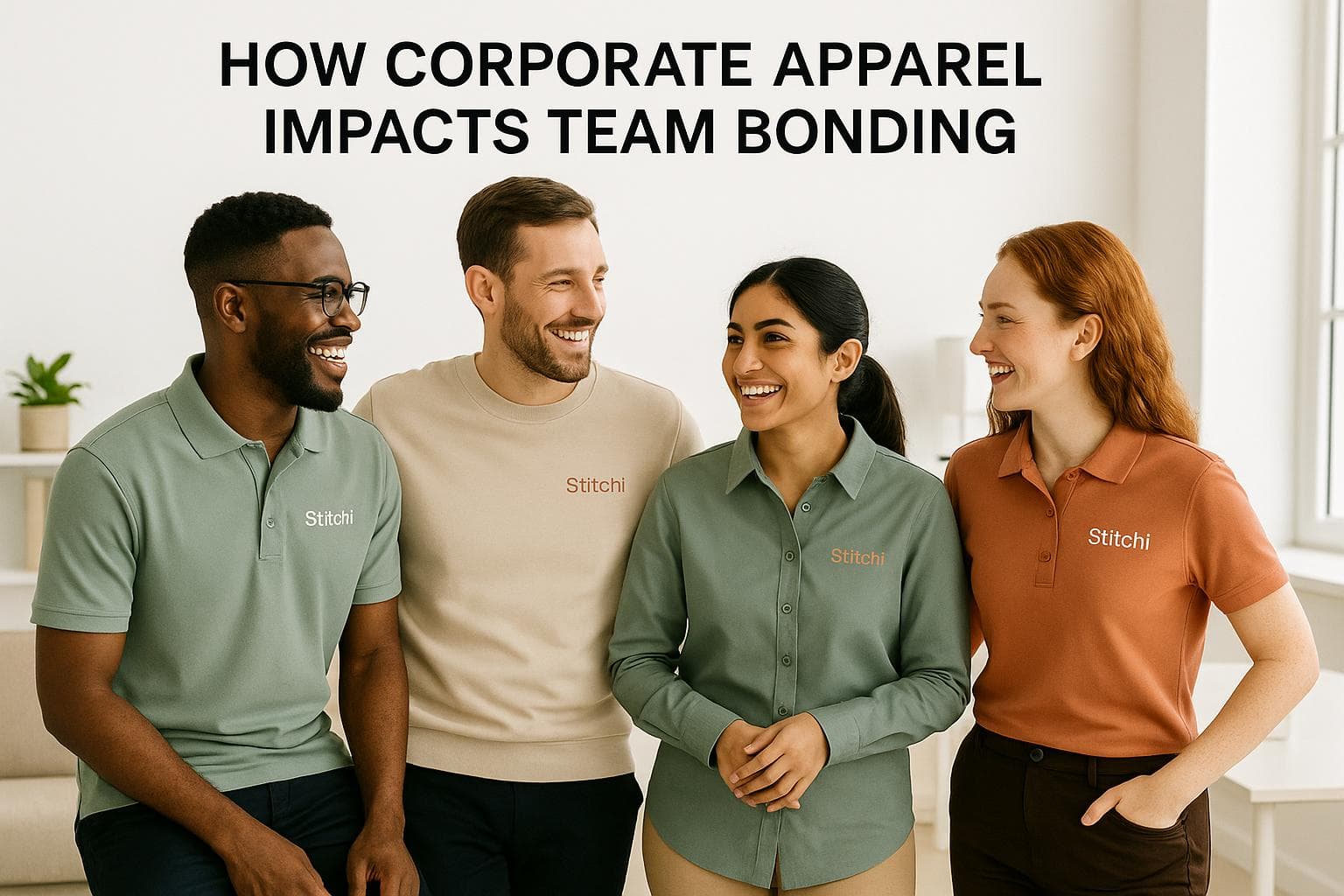
How Corporate Apparel Impacts Team Bonding
Corporate apparel isn’t just about uniforms - it’s a tool that strengthens team connections, boosts morale, and amplifies brand visibility. By creating a shared identity, branded clothing helps employees feel part of a team and reinforces unity every time it’s worn. Unlike one-off team-building events, apparel has a lasting impact and serves as a daily reminder of shared goals.
Here’s why it works:
- Longevity: Branded apparel keeps reinforcing team identity over time.
- Cost-Effectiveness: A one-time investment with long-term benefits.
- Inclusivity: Can be designed to suit all employees, regardless of role or location.
- Scalability: Works for small teams or global organizations with minimal logistics.
Corporate apparel also doubles as free marketing, turning employees into walking brand ambassadors. When thoughtfully designed, it builds pride and connection, making it a practical and enduring way to enhance team engagement.
How Custom T-Shirts Make Team Building 10X Better!
1. Corporate Apparel
Corporate apparel serves as a constant reminder of shared identity, strengthening team connections over time. Unlike single events that might fade from memory, branded clothing creates ongoing touchpoints that reinforce a sense of belonging every day. Here’s a closer look at why this approach works so well.
Longevity of Impact
Corporate apparel offers a lasting way to build team identity. Its impact goes far beyond the initial gesture. For instance, when a company hands out branded jackets during a retreat, the connection doesn’t end when the event does. Every time employees wear those jackets, it reinforces a shared purpose and strengthens loyalty. It’s a daily reminder of being part of something bigger.
This kind of clothing often turns into a "wearable memory." Whether it’s a hoodie given during onboarding or a t-shirt commemorating a big win, these items become symbols of shared experiences - celebrating successes, tackling challenges, or simply working together. A new hire, for example, who receives branded apparel on their first day carries that sense of welcome forward, helping them feel like part of the team right away.
Research supports this idea. Employees who feel included and valued from the start are more likely to stay engaged, contribute meaningfully, and advocate for the company’s culture over the long term. There’s even a psychological phenomenon, called enclothed cognition, which suggests that wearing such apparel can boost focus and confidence. Unlike temporary morale boosts from one-off events, these effects repeat every time the apparel is worn.
Cost-Effectiveness
From a financial perspective, corporate apparel delivers incredible value compared to other engagement initiatives. A team-building retreat might cost thousands of dollars per person and last just one day. Training programs often require ongoing investments in facilitators, materials, and time away from work. Branded apparel, on the other hand, is a one-time expense that keeps delivering benefits.
The value of this approach is twofold. Internally, it boosts morale and team identity. Externally, it turns employees into walking advertisements for the brand. At conferences or public events, matching apparel signals unity and increases brand visibility. Every time an employee wears the apparel outside of work, it’s essentially free marketing.
There’s also a practical benefit: reducing decision fatigue. When employees don’t have to spend time thinking about what to wear, they can focus their energy on their work. Studies show that simplifying decisions like this can increase engagement, motivation, and loyalty. For companies focused on retention, investing in quality apparel during onboarding can pay off by reducing turnover costs in the long run.
Inclusivity
To truly build team spirit, corporate apparel must be inclusive. The power of branded clothing lies in its ability to create a sense of unity, but this only works if everyone can participate. Companies need to offer a range of sizes, styles, and designs that accommodate different comfort levels and personal preferences.
When done right, branded apparel creates a sense of visual uniformity that erases distinctions tied to background, role, or status. Research shows that this kind of uniformity fosters trust and strengthens emotional bonds across all levels of an organization. However, this only happens if the apparel is genuinely accessible and comfortable for everyone. Offering diverse fits, extended sizing, and culturally sensitive designs ensures no one feels excluded.
The impact is significant. When employees see their colleagues as equals - rather than being defined by personal fashion choices - it promotes a sense of belonging. Smart companies extend this inclusivity to contractors, temporary staff, and support teams, making sure everyone feels part of the organization.
Studies have found that employees who wear branded apparel designed with inclusivity in mind report higher engagement levels. When the clothing fits well and feels comfortable, it becomes a source of pride rather than an obligation. This simple gesture signals that the company values its people, creating a stronger emotional connection.
Scalability
One of the greatest strengths of corporate apparel is how easily it scales. Whether you’re a small startup or a global corporation, the principle remains the same: matching outfits foster team chemistry.
Smaller teams might start with basic branded t-shirts or hoodies to create immediate cohesion. As the company grows, the program can expand. For example, departments could have their own designs that reflect their unique identities while maintaining overall brand consistency. A sales team might get one style, while the engineering team gets another, but all designs tie back to the larger organization.
Modern tools make scaling even simpler. Platforms like Stitchi provide centralized control over inventory, procurement, and global distribution. This makes it easy to manage logistics, whether you’re shipping a few dozen hoodies to one office or coordinating multiple styles across different countries.
The flexibility of corporate apparel programs is another advantage. Companies can tailor their approach to fit their needs: onboarding kits for new hires, gear for team-building events, performance-based rewards, or even limited-edition apparel for major milestones. A startup might begin with onboarding swag, then expand to event gear as they grow, eventually building a full merchandise ecosystem with jackets, caps, and more.
This adaptability means companies can align their apparel program with their budget and growth stage. Start small, track the impact through engagement and retention metrics, and scale up as needed. The infrastructure supports growth without forcing a one-size-fits-all approach, making it a practical and effective strategy for organizations of all sizes.
2. Other Team Engagement Methods
While corporate apparel has shown its effectiveness in fostering team unity, organizations often explore additional strategies to strengthen employee connections. However, these traditional approaches tend to lose their impact more quickly than the enduring benefits of corporate apparel. Comparing these methods across key factors can help companies make smarter choices about their engagement efforts.
Longevity of Impact
Activities like team-building exercises and company retreats often create a burst of enthusiasm and camaraderie during the event itself. For instance, a retreat might temporarily bring colleagues closer, but once everyone returns to their regular routines, that sense of connection often fades. Similarly, professional development sessions may inspire employees in the moment, but the effects rarely last beyond the event.
Cost-Effectiveness
Traditional engagement strategies can come with hefty recurring expenses. Retreats and off-site events, for example, often require significant spending on venues, facilitators, travel, and even lost productivity. These costs can quickly add up, especially for larger organizations. On top of that, these activities usually benefit only those who can attend, making them less efficient as a long-term investment in morale.
Inclusivity
Many conventional engagement activities unintentionally exclude certain employees. High-energy group exercises, for example, may feel overwhelming for introverts or those with social anxiety, while physical activities might not be accessible to employees with disabilities or health conditions. Geographic barriers and rigid scheduling can also make it hard for remote workers or those on alternative shifts to participate. Additionally, cultural differences may render some activities less effective or even alienating for certain groups, highlighting the need for more inclusive approaches.
Scalability
As organizations grow, scaling traditional engagement methods becomes increasingly difficult. Coordinating events across multiple departments, locations, and time zones requires significant administrative effort and often results in inconsistent experiences. The associated costs and logistical challenges mean these methods are typically limited in frequency and impact, making it hard to sustain their benefits over time. This highlights the importance of finding strategies that can deliver both lasting and scalable results.
sbb-itb-6f489d9
Advantages and Disadvantages
Corporate apparel and traditional engagement methods each bring their own set of strengths and weaknesses. Let’s explore how these two approaches stack up against each other.
The Core Trade-Offs
Corporate apparel offers something unique: "wearable memories" that consistently reinforce team identity over time[1]. This idea ties into enclothed cognition, which suggests that what we wear can subtly influence our mindset and even boost confidence[2]. On the other hand, traditional engagement methods like workshops or retreats focus on creating immediate, shared experiences. While these events can spark strong interpersonal connections, their impact is often short-lived and requires active participation.
Now, let’s talk about cost. A $30 branded hoodie that gets worn 100 times breaks down to just $0.30 per wear. Compare that to a $100 team-building event, which provides engagement for one day only[1]. Of course, this cost advantage only holds if employees actually enjoy and wear the apparel. If the clothing ends up in the back of a closet, its value diminishes - just like a one-off event that fails to leave a lasting impression.
Another big win for corporate apparel is scalability. Distributing branded items is relatively simple, whether you’re catering to a small team or a global workforce. In contrast, organizing large-scale events can quickly become a logistical nightmare, with challenges like scheduling, venue coordination, and higher costs[1]. For companies with remote teams spread across time zones, apparel programs offer a consistent way to connect without requiring everyone to participate at the same time.
Detailed Comparison
| Factor | Corporate Apparel | Traditional Engagement Methods |
|---|---|---|
| Longevity of Impact | Reinforces belonging over months or years with each wear[1] | Short-term boost; effects fade quickly |
| Cost-Effectiveness | One-time investment ($15–$50/item) with low per-wear cost[1] | Recurring expenses ($50–$200+ per employee) |
| Inclusivity | Accessible to remote workers and those with constraints[1] | May exclude employees unable to attend |
| Scalability | Easily scaled with minimal logistics[1] | Becomes more complex as team size grows |
| Psychological Impact | Builds identity and unity through enclothed cognition[2] | Strengthens bonds via shared experiences |
| External Brand Value | Employees act as walking ambassadors with branded apparel[1] | Benefits remain internal |
| Skill Development | Reinforces team identity but doesn’t build new skills | Provides learning and professional growth |
| Conflict Resolution | Doesn’t directly address interpersonal issues | Can help resolve conflicts through facilitation |
The Inclusivity Paradox
One of the biggest strengths of corporate apparel is its inclusivity - it doesn’t require physical attendance, making it accessible to all employees, including those working remotely or with limited mobility[1]. Studies show that well-designed uniforms can enhance confidence and create a sense of equality[2]. However, this inclusivity can backfire if the apparel isn’t thoughtfully designed. For example, offering a one-size-fits-all option or failing to consider diverse body types and preferences can alienate some employees.
When Each Approach Falls Short
Both methods have their limitations. Corporate apparel, while great for fostering visual unity, lacks the dynamic interaction and problem-solving opportunities that come with traditional engagement methods[1]. Plus, if the clothing isn’t comfortable or stylish, employees might not wear it, reducing its impact. On the flip side, traditional engagement activities often deliver short-lived results, require significant recurring costs, and present logistical challenges - especially for remote or distributed teams.
The External Visibility Factor
One area where corporate apparel shines is brand visibility. Employees wearing branded clothing outside of work essentially become walking advertisements for the company[1]. However, this benefit depends on the apparel being appealing enough for employees to wear in their personal lives.
The Quality Imperative
At the end of the day, success boils down to execution. For corporate apparel to work, it needs to be stylish, comfortable, and high-quality. Employees are more likely to embrace clothing they actually enjoy wearing, which strengthens team identity and morale. Poorly designed or uncomfortable apparel, on the other hand, can have the opposite effect[1].
Neither approach is a perfect solution on its own. Corporate apparel offers a cost-effective, scalable way to reinforce team identity, while traditional engagement methods provide opportunities for direct interaction and skill-building. The best strategy? A thoughtful mix of both. For companies looking to maximize the impact of corporate apparel, partnering with a tech-savvy branded merchandise agency like Stitchi can simplify the process of creating and distributing on-brand, high-quality apparel that employees will love.
Conclusion
Corporate apparel continues to stand out as a lasting and effective way to boost team engagement. Studies highlight how branded clothing strengthens team identity, turning company culture into something employees can see and feel every day[3]. Unlike short-lived team-building events, apparel serves as a constant reminder of a shared mission and values.
What makes corporate apparel so impactful is its ability to work on two fronts: it fosters a sense of equality within the team and amplifies brand visibility outside the workplace[1][3]. Imagine an employee getting a compliment on their company hoodie at a coffee shop or gym - it’s a small moment that can spark pride in their workplace, something internal initiatives alone often struggle to achieve.
Of course, quality matters. If the apparel is uncomfortable or poorly designed, it’s likely to be ignored, wasting both effort and resources. For this strategy to work, employees need to want to wear their branded items beyond office hours[4]. High-quality, stylish designs can transform these items from mere workwear into something employees value and enjoy.
The best results come when corporate apparel is paired with meaningful experiences. Use it to mark milestones, celebrate achievements, or welcome new hires during onboarding[1]. A well-designed hoodie from a product launch or a jacket celebrating a company anniversary carries sentimental value, turning these items into wearable memories rather than just another piece of clothing.
If you're looking to elevate your corporate apparel strategy, start by understanding what resonates with your team and aligns with your brand. Partner with vendors who can deliver premium, on-brand items that employees will proudly wear. When combined with other engagement efforts, corporate apparel can strengthen loyalty, improve communication, and help build a workplace culture where everyone feels connected to something bigger than themselves.
FAQs
How does corporate apparel promote inclusivity in a diverse workplace?
Corporate apparel has the power to bring people together by promoting a sense of unity and shared identity among employees, no matter their backgrounds. When everyone dons the same branded attire, it shifts the focus to being part of the team, rather than highlighting individual differences. This shared look helps foster a stronger connection among employees and reinforces their value within the group.
Offering options like different sizes, fits, and styles takes this a step further, ensuring that everyone feels comfortable and included. Designing with diversity in mind not only supports inclusivity but also strengthens employees’ pride in being part of the organization.
How does wearing corporate apparel strengthen team bonds?
Wearing corporate apparel can play a big role in bringing teams closer together by creating a strong sense of unity and shared purpose. Branded clothing acts as a visual reminder that every individual is part of a larger group working toward the same objectives. This shared identity can lift spirits, promote teamwork, and help forge stronger connections among colleagues.
It also has the added benefit of reducing focus on personal differences, like individual fashion choices, and instead highlights the collective identity of the team. This can help cultivate a more inclusive atmosphere where employees feel connected and appreciated. For instance, teams wearing branded apparel at events or in the office often report feeling more united and motivated, which naturally leads to better communication and higher productivity.
How does corporate apparel help with team bonding compared to traditional team-building activities?
Corporate apparel plays a powerful role in strengthening team connections by creating a sense of unity and shared purpose among employees. Unlike one-off team-building events, branded clothing acts as a constant reminder of belonging and togetherness. When employees wear apparel that embodies their company’s values and culture, it reinforces a sense of pride and builds camaraderie on a daily basis.
From a budget perspective, corporate apparel is a smart, long-lasting investment. A thoughtfully designed piece of branded clothing can be worn time and time again, providing ongoing engagement without the need for repeated spending. In contrast, team-building events, while impactful, often come with higher upfront costs and require extensive planning for a single occasion. Incorporating corporate apparel into your strategy offers a scalable and lasting way to nurture team bonds.